
Deeper Than a Bonding Curve
Wake up, degen. Let's see how deep the rabbit hole goes.

Most launchpads give every token the same market: one curve, one quote, one pool. Pick a name, pick an image, done. On Abyss, the market is the part you get to design.
Everything is a setting
One launch can open up to 16 pools across Abyss and Uniswap v4, against up to seven quote tokens, with up to 32 liquidity positions between them. Every pool is its own market, with its own venue, quote token, share of the supply, fee and, on Uniswap, hook. Its liquidity follows a preset or whatever ranges you drag onto the chart yourself.
You set one launch price in dollars and every pool is priced from it, so a pool against ETH and a pool against a tokenized stock open at the same market cap. The chart up top stacks every pool by color, so you're looking at one launch instead of three spreadsheets.
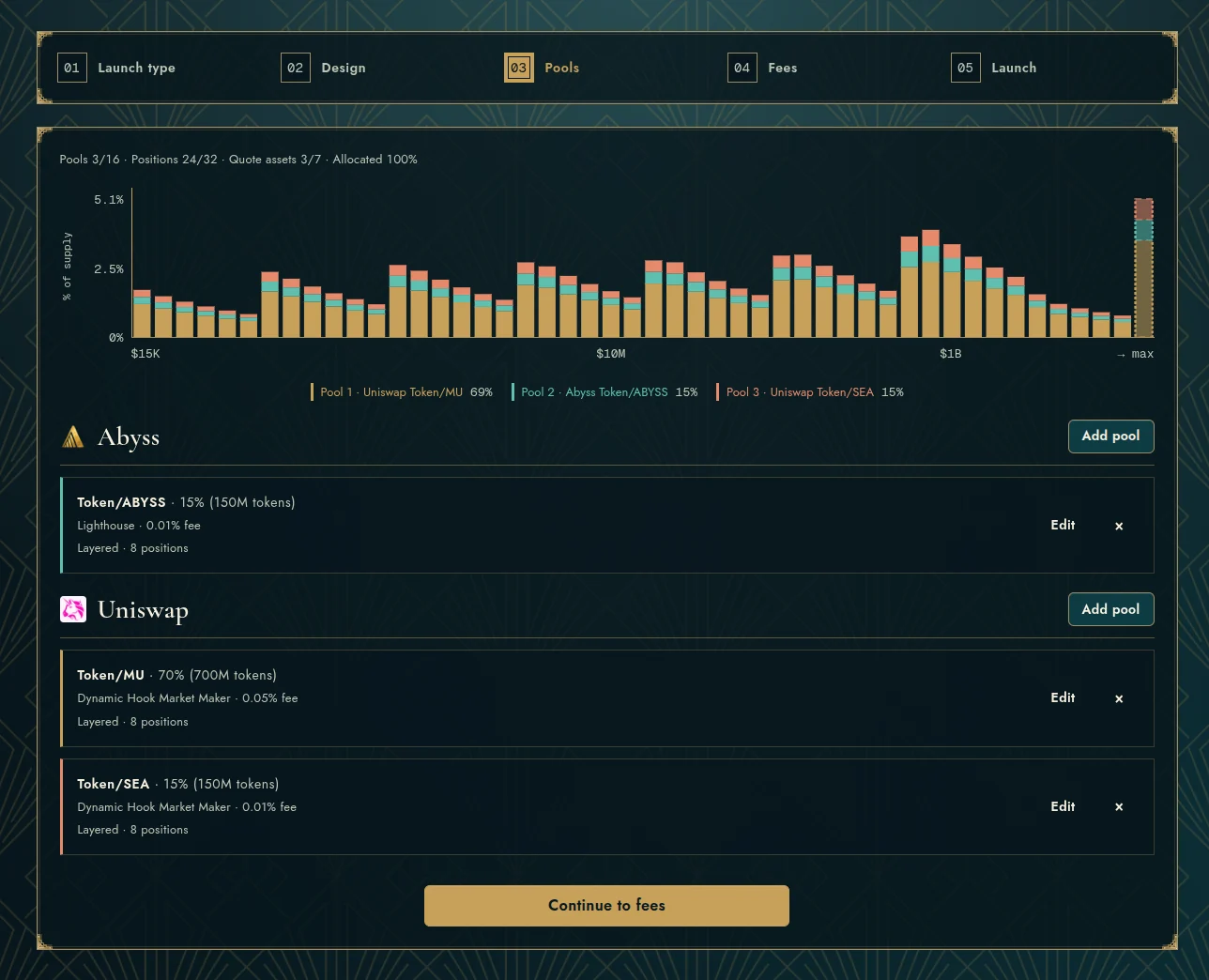
Then you pick ERC-20 or DN-404, where the trading fees go and how big an opening buy to make.
You don't have to be the one who launches it, either. Setups save as you go, and every draft has its own short link. Build the whole thing, send the link to a friend, and they land on the same step with every pool, price and shape already filled in. Their wallet takes over the parts that belong to whoever launches, like fee recipients. They add an image and hit launch. A link stays alive for a day after the last edit.
Who gets the supply
None of that matters if the first wallet in walks off with most of the token, and a bonding curve is built to let it. On Pons, the first $1,000 into a new ETH launch buys a fifth of the supply. Half the token is gone before a $16,000 market cap, and 71% by the time it graduates at around $50,000. pump.fun gets there with different numbers. A curve is one wide range that starts cheap, and the cheap end is where the supply lives.

Pons does tax early buys, 99% at launch and nothing after three seconds. The creator's wallets and up to 32 friends on an exemption list skip it, and on one launch those exempt wallets bought out the entire curve in the same second it opened. A tax window decides who gets to be first. It doesn't change how much cheap supply is waiting for them.
The shape of the liquidity does. Abyss launches put the token straight into positions above the opening price, and every pool picks one of four shapes. Single range is one position from the opening price to the moon. Even spread lays seven positions end to end with the same number of tokens in each. Layered stacks seven overlapping positions that all run to the same high price, so depth keeps piling up as the price climbs. Higher ground saves more of the supply for higher valuations.

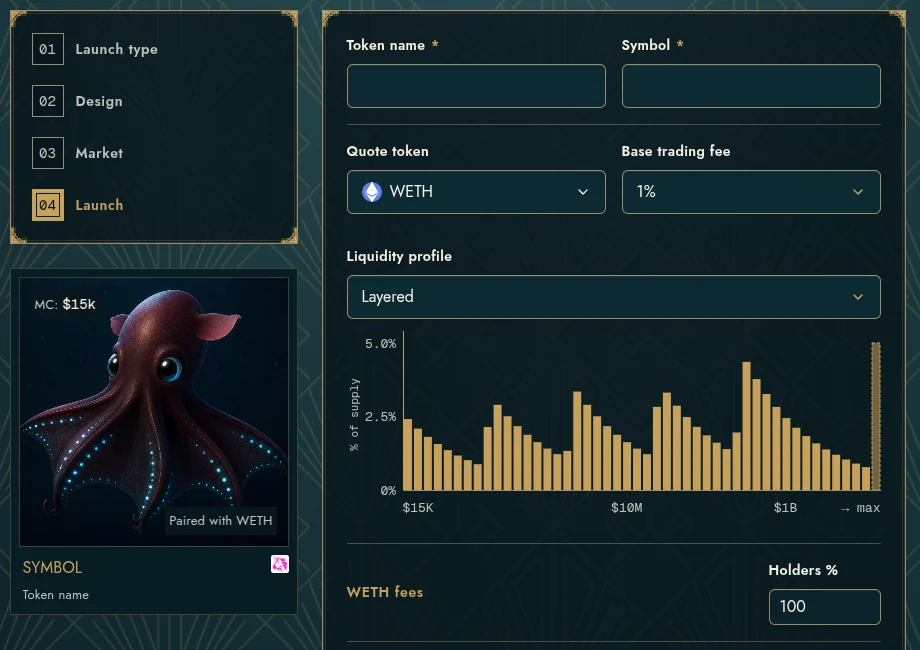
Layered is the default. With eight positions opened at $15,000, the first $1,000 gets 4.4% of the supply, only 8.8% is sold by $100,000, and half isn't gone until around $34 million. The overlapping ranges keep stacking depth, so there's about $3.9 million of buyer money in the pool at a $50 million market cap, against under $500,000 for a Single range opened at $5,000.
The trade-off is a thinner early market: at $50,000, a $1,000 buy moves a Layered pool about 65%. Higher ground pushes that too far, with about $520 of buyer money in the pool at the same point. The opening price matters as much as the shape. Opened at $5,000, Layered gives the first $1,000 7.9% of the supply. At $30,000 it's 2.6%, which is fairer but a bit rich for a meme nobody's heard of yet. $15,000 is the default and the floor.
The rabbit hole, in practice
On a recent three-pool launch, the creator's opening buy, 0.16% of the supply, landed in the same transaction that opened the pools, so nobody could get in front of it. Twelve hours later only 0.24% of the supply had left the pools. Then the buyers arrived, and about 12% went in the next seven hours. Some has been sold back since, and the token sits at roughly a $105,000 market cap with 8.7% of its supply out of the pools, right where Layered says it should be.
Nobody got the bag. The biggest holder, an app wallet, has 1.3% of the supply, and the ten biggest wallets hold 2.8% between them. Even the bots came up short: nine high-volume wallets with matching vanity addresses fired identical buys in the same minute and ended up with 1.2% between them. On a bonding curve, three quarters of the supply would be gone by this market cap.
Simple, for everyone else
Not every token needs three markets. Simple is the same engine with the decisions made for you: one pool, one transaction, Layered at $15,000. A Simple pool gets six positions instead of eight, so a little more goes early, about 11% by $100,000. Pick Abyss or Uniswap, pick a quote token, check the chart and launch. On Uniswap the pool runs our Dynamic Hook Market Maker by default, a hook that moves the fee with the market and spends part of it buying dips and selling back above cost.
How deep it goes
Three pools was the warm-up. The limit is sixteen. Somewhere out there is a token that wants all of them, and we'd like to see the chart.
Changelog
- Advanced launches: up to 16 pools across Abyss and Uniswap v4, seven quote tokens and 32 liquidity positions, all priced from one dollar launch price.
- Liquidity presets on every pool: Single range, Even spread, Layered and Higher ground, plus Custom ranges you drag on the chart, overlaps allowed.
- Layered and a $15,000 opening are the new defaults, and $15,000 is the lowest opening on Advanced.
- Simple launches on Uniswap use the Dynamic Hook Market Maker by default, and a launch can run up to four Hook Market Maker pools.
- A 0.01% fee tier on Abyss and Uniswap pools.
- Drafts save as you go and share as a link.
- Simple launches go out in one transaction.
From the depths...
App: app.abyss.trading
Docs: docs.abyss.trading
Blog: blog.abyss.trading